




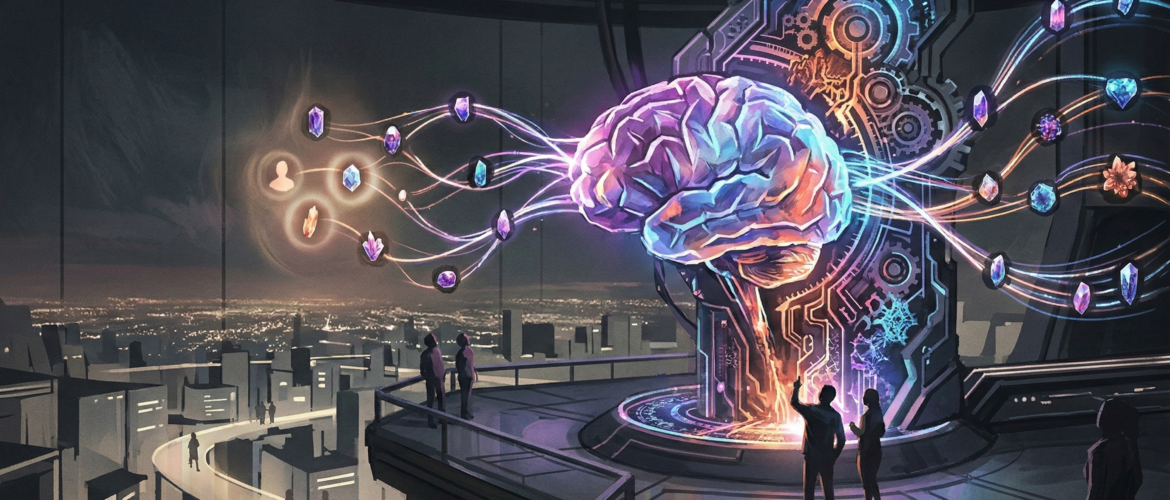
The Discovery Engine: How Social Commerce is Rewiring the Customer Journey in 2026
Forget the social feed as you know it. The endless scroll of 2024—a fragmented landscape of vacation photos, memes, and interruptive advertising—is on the verge of a profound evolution. By 2026, we won’t be talking about social media marketing in terms of channels or funnels. We will be talking about the Discovery Engine: a deeply intelligent, AI-powered reality where the line between content and commerce is not just blurred, but completely erased.
The core argument is this: marketers are no longer just competing for attention within the feed; they are becoming architects of serendipity. We are moving beyond the era of interruption and into an age of integration. Using algorithmic curation and generative AI, brands can now embed commerce so naturally into a user’s discovery journey that the path from inspiration to purchase feels less like a sales tactic and more like a personal revelation. This isn’t about placing ads. It’s about building worlds and inviting customers in.
The Algorithmic Shift: From Personalization to Predictive Curation
For the past decade, personalization has been the gold standard. Algorithms analyzed past behavior—clicks, likes, shares, and purchases—to serve users more of what they already knew they wanted. It was a reactive model, effective yet limited. It could show you another pair of running shoes, but it couldn’t predict your sudden desire to take up trail running next spring.
The Discovery Engine of 2026 operates on a different plane: predictive curation. This new generation of AI doesn’t just analyze your past; it synthesizes vast datasets—contextual clues, emerging cultural trends, network sentiment, and even biometric feedback from wearables—to anticipate future intent. It’s the difference between a helpful store clerk who finds the item you ask for and a master stylist who introduces you to a designer you’re about to become obsessed with.
How Predictive Curation Reshapes the Feed
This algorithmic shift turns passive scrolling into an active state of ‘always-on’ discovery. The feed becomes a blended reality where a friend’s travel video seamlessly transitions into a shoppable guide for the same destination, curated with AI-suggested travel gear based on your style profile. A creator’s tutorial on sustainable cooking might feature a smart pan that you can add to your cart without ever leaving the video player. Generative AI will create millions of content variations on the fly, ensuring the product placement within a piece of content feels native and hyper-relevant to each individual viewer. The result is a user experience where every scroll has the potential to solve a problem or fulfill a desire the user was only subconsciously aware of.
Authenticity as the New Conversion Engine
As the algorithm becomes more sophisticated, so too must the content that feeds it. The polished, high-production-value brand ad is an artifact of a bygone era. In the Discovery Engine, the primary currency isn’t polish; it’s authenticity. The algorithm has learned a fundamental human truth: we trust people more than we trust logos.
Human-centric, short-form video and genuine brand storytelling are no longer top-of-funnel engagement plays. They are the primary drivers of high-intent conversions. Why? Because the Discovery Engine is optimized for emotional resonance. It prioritizes content that feels real, relatable, and trustworthy because that is the content that primes a user for purchase. A raw, unscripted testimonial from a creator who genuinely loves a product carries more conversion weight than a multi-million dollar campaign because it builds instantaneous trust.
From Storytelling to Sales in a Single Tap
This new paradigm fundamentally changes our approach to content. We must stop thinking in terms of ‘brand content’ versus ‘direct response.’ They are now one and the same. The narrative is the conversion tool. This shift underscores a critical principle we’ve seen gaining momentum: even in an age of powerful automation, authenticity often outperforms automation when it comes to building genuine customer relationships.
When this authentic content is paired with native checkout environments—like TikTok Shop, Instagram Checkout, or YouTube Shopping—the effect is exponential. The emotional peak created by a compelling story is immediately followed by a frictionless path to purchase. The user goes from ‘I love that’ to ‘It’s mine’ in two taps, eliminating the consideration-phase drop-off that has plagued marketers for years.
Architecting Serendipity: A Framework for the New Customer Journey
To win in 2026, brands must transition from campaign-based thinking to journey-based architecture. It’s not about launching a product; it’s about building a digital legacy where every piece of content is a breadcrumb leading customers on a journey of discovery. Here is a framework for mapping this new reality.
1. Map the ‘Discovery Spectrum,’ Not the Funnel
The linear AIDA (Awareness, Interest, Desire, Action) funnel is obsolete. The modern journey is a fluid spectrum. Brands should map their content strategy across three key phases:
- Inspiration: This is top-of-spectrum content that solves a problem or taps into an aspiration without an overt sales pitch. Think ‘how-to’ guides, entertaining stories, or trend-spotting videos where your brand or product plays a natural role.
- Validation: Here, the algorithm surfaces social proof. This includes creator reviews, user-generated content (UGC), testimonials, and product-in-action videos. This content answers the user’s implicit question: ‘Is this right for me?’
- Acquisition: This is the moment of conversion. The content here is direct and value-driven, often featuring a limited-time offer or exclusive access, leading directly to a native checkout.
2. Weave Commerce into Narrative Threads
Your products should not be the heroes of your stories; they should be the tools the hero uses. Build a brand world with a consistent narrative, and place your products within it as essential artifacts. A skincare brand, for example, shouldn’t just sell a serum. It should tell the story of ‘the 5-minute morning ritual for reclaiming your day,’ where the serum is a key plot device. This requires a holistic view that connects top-of-spectrum narrative with bottom-of-spectrum performance, a core tenet of mastering an integrated performance marketing strategy. Generative AI can then scale this by creating thousands of narrative variations to suit different audience segments, ensuring relevance at an unprecedented scale.
3. Design for Frictionless Conversion at Peak Emotion
The single greatest advantage of the Discovery Engine is its ability to capture intent at its absolute peak. The moment a user feels that spark of ‘I need that,’ any friction—a slow-loading website, a complicated checkout form, or even just leaving the app—can extinguish it. Therefore, optimizing for native and in-app social commerce isn’t just a best practice; it is the entire ballgame. Every journey you architect must lead to the most seamless, integrated, and frictionless conversion point possible. Every click removed from the process is a measurable lift in ROI.
The Future is Curated, Not Advertised
The evolution of social commerce into a true Discovery Engine represents one of the most significant marketing shifts of the decade. We are leaving behind the blunt instruments of interruption and embracing the fine art of algorithmic serendipity. The brands that thrive in this new ecosystem will be those that understand this fundamental truth: you are not just selling a product; you are curating an experience. They will be the ones who respect their customers enough to guide, not push; to inspire, not interrupt. They will build their strategies around authentic storytelling and frictionless technology, creating customer journeys that feel so personal and intuitive, they cease to feel like marketing at all.